


Open AI’s first API came out in 2023. By now, there should be $10/mo engineering tutor with MIT level open courseware support to speed run PhD level topics with morning coffee.
Or the Cursor for learning with a platform experience with great memory and context management for exploring any topic. Neither of those exist yet. At least, not at scale to our knowledge.
There’s been a lot of progress in other industries and applications:
codegen with Codex, Devin and Claude Code,
design with Variant, Figma Make,
and even legal with Harvey AI and health, Open Evidence and Abridge.
Not enough in education.
Yet, there’s so much potential in unlocking the latest models of education with the latest AI tools.
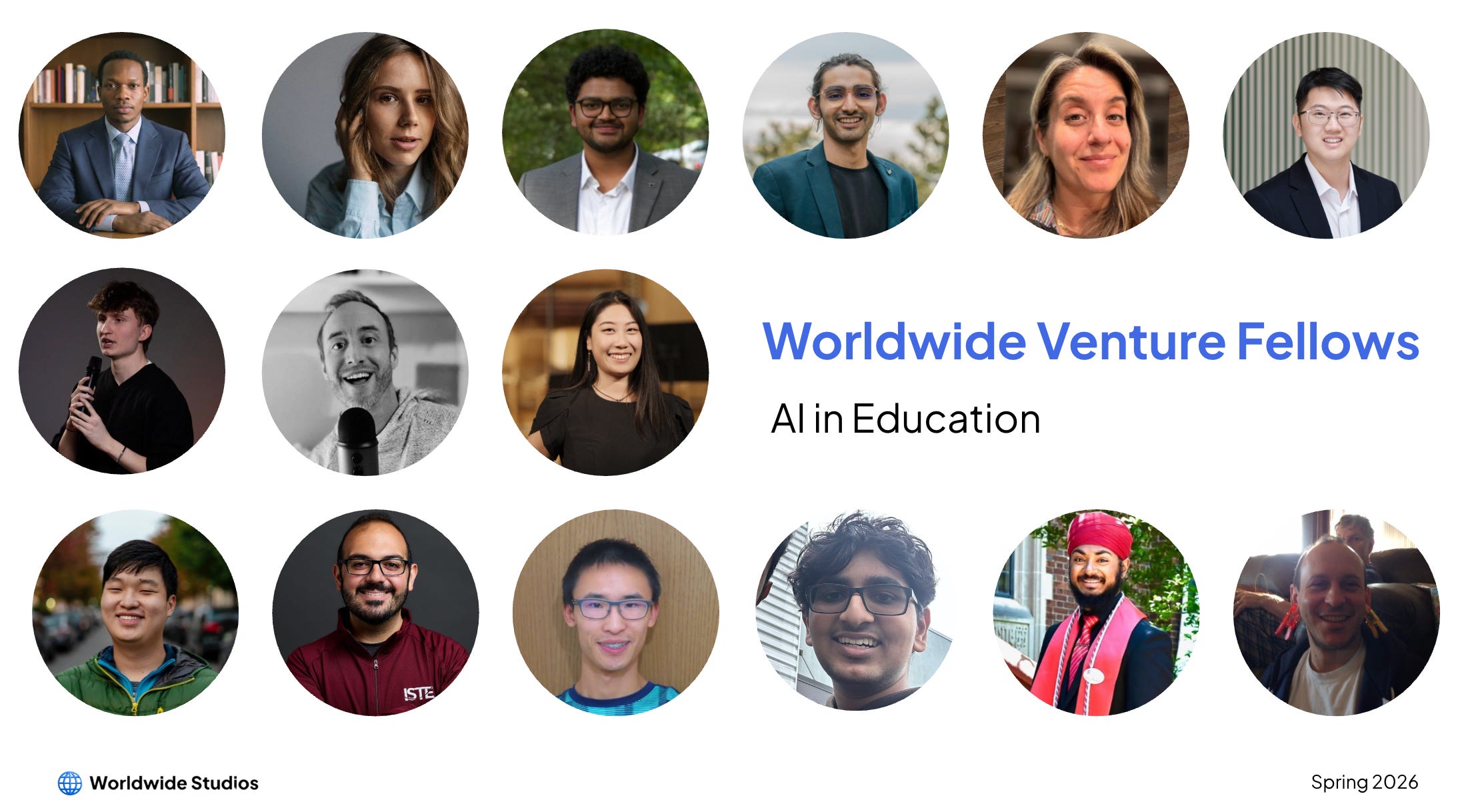
So we launched a venture fellowship to accelerate new solutions today to yesterday’s age old problems. From K12 personal tutors to new live assessments for hiring, fellows will explore and build their own ideas in small teams.
100 days. Weekly progress. From idea to real impact with first pilots.
Here are the fellows
Jeremiah ‘Jay’ Johnson is an AI native storyteller and educator who helps run global workshops for teams.
Vedansh Mannem started a math tutoring non-profit and is now exploring new AI tools, like an SAT question generator for practice tests.
Xiangan He runs a dev shop that’s worked with clients like Google, State Street, and YC-backed startups. He’s building what he wish he had in early education.
Barbara Jauregui Wurst founded an Acton Academy alternative school in the DC area inspired by her own kids’ love of learning. She wants to see new tools for young people to thrive.
Lilian Gong is a learning engineering researcher at ASU who built a French tutor bot using a multi-agent LLM system. She’s exploring alternatives way to cultivate and assess skills and knowledge outside of trad homework.
Oleksandra ‘Sasha’ Pariy is a CEO and product builder. She’s built a vector embedding database for a professor to let students chat with large PDFs and get accurate citations.
Scott Nicoll has 10+ years teaching critical thinking in Asia, now exploring a contrarian tutor to help cultivate self awareness and independent thinking.
Feodor is in Saint Petersburg building a startup community at ITMO and exploring global education opportunities.
Ryan Leong has experience across startups in underwater robotics and real estate and is now exploring ways to increase AI literacy for young people.
Harsh Thakkar is in an applied global program in Accra, Ghana, partnering with public school teachers to design hands-on learning models.
Michael Davola runs tech staff development at a public school on Long Island in New York. He built a self-reflection coach in video form to help students make video journal entries.
Maruthi Vemula built an adaptive system to figure out what to learn next, moving away from fixed curriculums.
Morgan Hough is a researcher focused on computational psychiatry and cerebral organoids. He explored Zuna, a brain foundation model using EEG data.
Joseph Ching is a Higher Education Program Manager who wants to build AI literacy for current students and explore new models for accreditation.
Jasjeev Singh has been working on ways to support neuro-developmental care and education. He built a children’s game for families around learning styles.
And if you have a community or a school that wants to try out the latest tools that get built, reach out.
